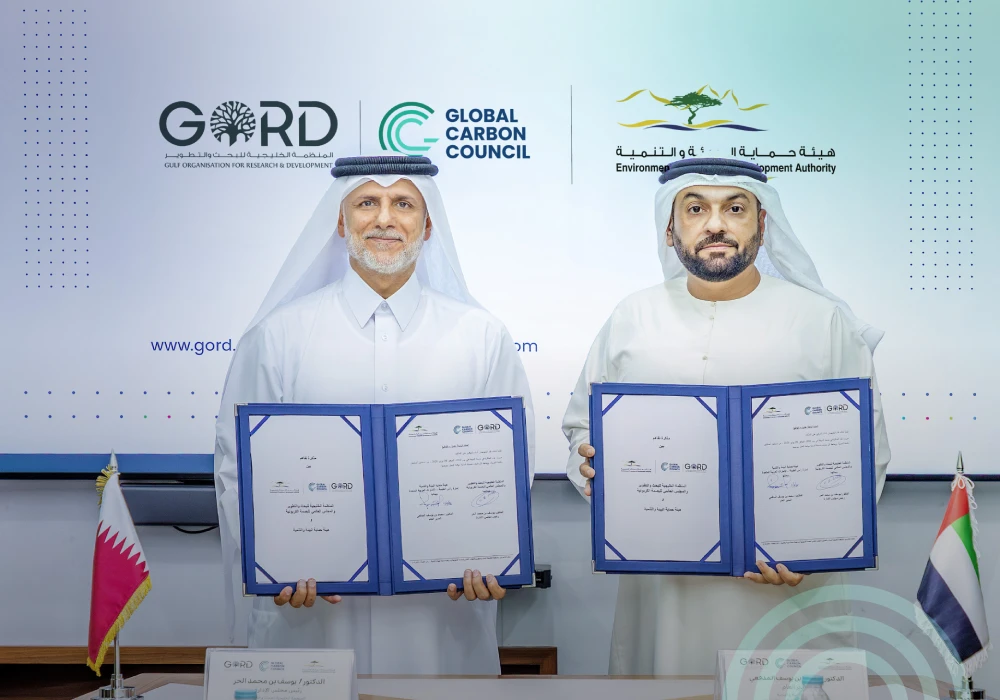

The Global Carbon Council (GCC) convened a high-level dinner dialogue in Bonn, Germany, on 11 June 2026, bringing together country representatives, carbon market experts, and stakeholders to discuss practical pathways for operationalizing Article 6.2 and strengthening country readiness for high-integrity carbon market implementation.
Held on the sidelines of the UNFCCC Subsidiary Bodies (SB) sessions, the dialogue focused on the growing need to move from carbon market policy frameworks to operational systems capable of supporting international cooperation under Article 6.2 of the Paris Agreement.
The discussions highlighted that while countries are increasingly advancing Nationally Determined Contributions (NDCs), domestic carbon market frameworks, and bilateral cooperation arrangements, significant efforts are still required to establish the operational infrastructure needed to support carbon market transactions, tracking, accounting, and reporting.
Opening the dialogue, Dr. Yousef M. Alhorr, Founding Chairman of GCC, emphasized the importance of strengthening institutional and digital infrastructure to support the next phase of carbon market development.
“We are meeting at a critical juncture in global climate action. For developing nations, navigating the complexities of the Paris Agreement requires not just ambition, but robust institutional infrastructure to back it up. By strengthening carbon market systems, enhancing transparency, and building technical capacity, countries can better access climate finance, meet their reporting obligations, and participate effectively in international carbon market cooperation,” said Dr. Alhorr.
Participants exchanged perspectives on key implementation challenges, including digital infrastructure requirements, registry systems, monitoring, reporting and verification (MRV), corresponding adjustments, transparency requirements, and interoperability across national and international carbon market systems.
The central theme of the discussions was the need to move beyond policy ambition and establish practical mechanisms that enable countries to authorize, track, transfer, and report mitigation outcomes with transparency and integrity. Discussions also highlighted the importance of governance structures, institutional readiness, authorization procedures, and benefit-sharing mechanisms in supporting effective Article 6.2 implementation.
As part of the dialogue, GCC presented its Integrated and Interoperable Carbon Market Infrastructure (CMI), designed to support countries in operationalizing Article 6.2 by deploying national registries to the countries, linking the credible independent carbon standards (ICSs) with the national registries and providing credible project registration systems, and transaction registries of ICSs’ to work in partnership with countries, facilitating ITMO tracking, corresponding adjustment management, and reporting functions aligned with UNFCCC requirements.
The presentation demonstrated how interoperable carbon market infrastructure can support countries in managing the full lifecycle of carbon assets while maintaining environmental integrity, transparency, and sovereign control over carbon market decisions. Participants also discussed the role of digital infrastructure in supporting corresponding adjustments, Biennial Transparency Report (BTR) requirements, and international carbon market transactions.
The dialogue further explored the importance of interoperability between national and international carbon market systems and the role such infrastructure can play in enabling countries to participate more effectively in international carbon markets while maintaining alignment with national priorities and climate objectives.
A key message emerging from the discussions was that the future success of international carbon markets will depend not only on policy frameworks and market demand, but also on the systems and infrastructure that allow countries to operationalize carbon market cooperation on a scale.
The dialogue generated significant interest in GCC’s Integrated and Interoperable Carbon Market Infrastructure (CMI) solution and its potential to support countries in operationalizing Article 6.2 carbon markets. Participants highlighted the value of practical, interoperable infrastructure that can help countries strengthen institutional readiness, manage carbon market transactions, and meet transparency and reporting requirements while maintaining environmental integrity and sovereign control over carbon market decisions.